
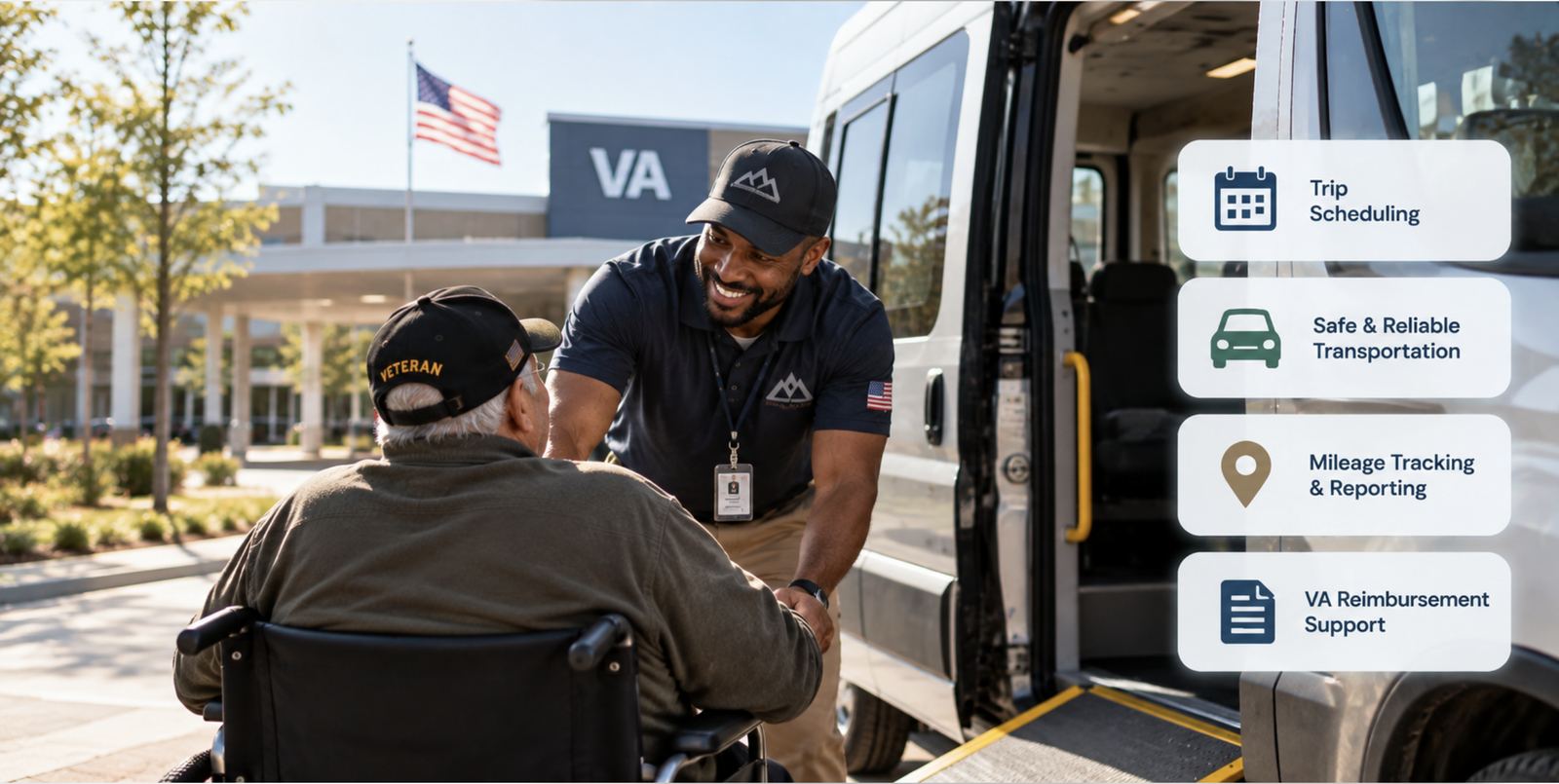
For many veterans, the hardest part of getting help is simply getting there. A ride to a VA medical appointment can decide whether a veteran gets the care they need. Veteran support organizations that provide transportation know how much coordination goes into every one of those rides, and how much reporting comes after.
We built a Samsara Salesforce integration to make that work simpler. Dispatchers schedule each trip in Salesforce. Drivers see their trips and log each leg in the Salesforce mobile app. Samsara sends vehicle and trip data straight into Salesforce as the ride happens. When the ride is done, the details the organization needs to report to the VA are already recorded: which veteran rode, how many miles, what times and what kinds of stops.
This article walks through how it works and why it matters for veteran support organizations.
The Problem: Rides Run on Phone Calls and Paper
Before an integration like this, veteran transportation often depends on a patchwork. Requests come in by phone or email. A dispatcher checks who is available, calls a driver and writes the details down. Drivers keep paper logs of odometer readings and times. At the end of the month, someone types it all into a spreadsheet to build the report the VA requires.
Every handoff is a chance for something to slip:
- A request is written down but never assigned.
- A driver is not sure which veteran to pick up, or when.
- Mileage is estimated or copied by hand instead of measured.
- The monthly report takes days to assemble and still has gaps.
The people doing this work want to serve veterans, not chase paperwork.
Two Systems, Each Doing What It Does Best
Salesforce and Samsara are each strong at different things.
- Salesforce is the system of record for people and services. It knows each veteran, their appointments, their case manager and the services they receive.
- Samsara is a fleet management platform. It knows the vehicles, where they are and what happens on every trip.
Instead of asking one system to do everything, we connected the two so each handles its part and the information flows between them automatically.
How It Works, Step by Step
- The dispatcher schedules the trip in Salesforce. Each trip includes the veteran, the appointment details, the assigned driver and vehicle, and the date and time. Because it lives in Salesforce, the trip is tied to the veteran's record and the services they are receiving.
- The driver sees and accepts it on their phone. Drivers use the Salesforce mobile app to see their trips for the current week and the weeks ahead. The app keeps working offline, which matters in rural areas where cell coverage is weak.
- The driver logs each leg. At every pick-up and drop-off, the driver taps to start and end that leg of the trip.
- Samsara sends the vehicle data. As the vehicle moves, Samsara sends trip, vehicle and start-and-stop data straight to Salesforce in real time.
- Salesforce matches it to the trip. The incoming data is matched to the right trip automatically, and the trip's manifest fills in with odometer readings, mileage and driving time for each leg.
Dispatchers see every trip's status without making phone calls. Drivers know exactly where to go. And no one has to type trip details in after the fact.
Reporting to the VA, Without the Scramble
Organizations that provide veteran transportation with VA support must report on that service. The VA wants to know which veterans were served, how far they traveled, when the rides happened and what kinds of stops were made.
With the integration, those details are captured as part of each trip, not rebuilt at the end of the month:
- Veteran. Each trip is tied to the veteran who received it.
- Miles. Odometer readings and mileage come from the vehicle itself, not an estimate.
- Times. The start and end of each leg and the driving time are recorded as they happen.
- Types of stops. Each pick-up and drop-off is logged as its own leg of the trip.
Because the information is already in Salesforce, the organization can pull its VA reporting from the same records its staff use every day. Reports that once took days of gathering and typing come together far faster, and the numbers are more accurate because they were recorded at the source.
Under the Hood: A Direct Connection, Built with AI
For the Salesforce administrators and developers reading, here is how the integration is built.
- Built with AI. We used AI to build and refine the integration, iterating quickly from the first working version to the finished connection. The result is a direct link between the two systems: Samsara webhooks send data to a custom Apex REST endpoint in Salesforce, so it arrives in real time with fewer moving parts.
- A staging step. Incoming trip, vehicle and start-and-stop data first lands on a staging record in Salesforce. That keeps raw data separate from the records staff work with every day.
- Automatic matching. Salesforce Flows match each staged record to the right trip and update the odometer readings, trip legs and vehicle activity.
Using AI let us design, write, test and adjust the connection much faster than a traditional build, while our team set the architecture and reviewed every piece. Read more about how AI is changing Salesforce development.
What It Means for the People Doing the Work
- Dispatchers spend less time on the phone and more time making sure every veteran who needs a ride gets one.
- Drivers get clear assignments on their phone and do not have to keep paper logs.
- Case managers can see the rides each veteran has received alongside the rest of their services.
- Leaders can report to the VA and other funders with confidence, and see how transportation fits into the organization's overall impact.
Transportation is one piece of a larger picture. To see how rides fit alongside intake, housing, workforce programs and grant reporting, read Built by Veterans for Veterans: Modernizing VSO Case Management.
Built by a Veteran-Owned Team
Visios is a veteran-owned Salesforce partner, and more than half of our team are veterans. We built this integration because we understand what is at stake when a veteran misses a ride. Our goal is to take the paperwork off your team's plate so they can focus on the veterans they serve.
If your organization provides transportation for veterans and is still running it on phone calls, paper logs and spreadsheets, let's talk about what a Samsara and Salesforce integration could do for you.
Frequently Asked Questions
What is a Samsara Salesforce integration?
It is a direct connection between Samsara, a fleet management platform, and Salesforce, so vehicle and trip data moves into Salesforce automatically. In our veteran transportation integration, trips are scheduled in Salesforce, drivers log each leg in the Salesforce mobile app, and Samsara's vehicle data fills in the miles and times.
Can drivers use it without cell service?
Yes. Drivers use the Salesforce mobile app, which keeps working offline in areas with weak coverage.
What information is recorded for VA reporting?
Each trip records the veteran who was served, odometer readings and mileage, the start and end of each leg, driving time and each pick-up and drop-off. Those details are in Salesforce, ready for reporting.
Do drivers still need to keep paper logs?
No. Odometer readings, mileage and times are captured in the trip's manifest, so drivers do not have to write them down and staff do not have to type them in later.